203.移除链表元素 题意:删除链表中等于给定值 val 的所有节点。
示例 1: 输入:head = [1,2,6,3,4,5,6], val = 6 输出:[1,2,3,4,5]
示例 2: 输入:head = [], val = 1 输出:[]
示例 3: 输入:head = [7,7,7,7], val = 7 输出:[]
思路:
使用cur来遍历链表结点
找到结点值为val的结点,对cur.next赋值为cur.next.next
代码:
1
2
3
4
5
6
7
8
9
10
11
12
13
14
15
class ListNode : def __init__ (self, val=0 , next =None ): self.val = val self.next = next class Solution : def removeElements (head, val ): tem_head=ListNode(next =head) cur=tem_head while (cur.next !=None ): if (cur.next .val==val): cur.next =cur.next .next else : cur=cur.next return tem_head.next
707.设计链表 题意:
在链表类中实现这些功能:
get(index):获取链表中第 index 个节点的值。如果索引无效,则返回-1。
addAtHead(val):在链表的第一个元素之前添加一个值为 val 的节点。插入后,新节点将成为链表的第一个节点。
addAtTail(val):将值为 val 的节点追加到链表的最后一个元素。
addAtIndex(index,val):在链表中的第 index 个节点之前添加值为 val 的节点。如果 index 等于链表的长度,则该节点将附加到链表的末尾。如果 index 大于链表长度,则不会插入节点。如果index小于0,则在头部插入节点。
deleteAtIndex(index):如果索引 index 有效,则删除链表中的第 index 个节点。
代码:
1
2
3
4
5
6
7
8
9
10
11
12
13
14
15
16
17
18
19
20
21
22
23
24
25
26
27
28
29
30
31
32
33
34
35
36
37
38
39
40
41
42
43
44
45
46
47
48
49
50
51
52
53
54
55
56
57
58
59
60
61
62
63
64
65
66
67
68
69
70
71
72
73
74
75
76
77
78
79
80
81
82
83
class Node : def __init__ (self, val=0 , next =None ): self.val = val self.next = next class MyLinkedList (object ): def __init__ (self ): self.head = Node() self.size = 0 def get (self, index ): """ :type index: int :rtype: int """ if index < 0 or index >= self.size: return -1 cur = self.head.next while (index): cur = cur.next index -= 1 return cur.val def addAtHead (self, val ): """ :type val: int :rtype: None """ new_node = Node(val) new_node.next = self.head.next self.head.next = new_node self.size += 1 def addAtTail (self, val ): """ :type val: int :rtype: None """ new_node = Node(val) cur = self.head while (cur.next ): cur = cur.next cur.next = new_node self.size += 1 def addAtIndex (self, index, val ): """ :type index: int :type val: int :rtype: None """ if index < 0 : self.addAtHead(val) return elif index == self.size: self.addAtTail(val) return elif index > self.size: return node = Node(val) pre = self.head while (index): pre = pre.next index -= 1 node.next = pre.next pre.next = node self.size += 1 def deleteAtIndex (self, index ): """ :type index: int :rtype: None """ if index < 0 or index >= self.size: return pre = self.head while (index): pre = pre.next index -= 1 pre.next = pre.next .next self.size -= 1
206.反转链表 题意:反转一个单链表。
示例: 输入: 1->2->3->4->5->NULL 输出: 5->4->3->2->1->NULL
思路:
首先定义一个cur指针,指向头结点,再定义一个pre指针,初始化为null。
然后就要开始反转了,首先要把 cur->next 节点用tmp指针保存一下,也就是保存一下这个节点。
为什么要保存一下这个节点呢,因为接下来要改变 cur->next 的指向了,将cur->next 指向pre ,此时已经反转了第一个节点了。
接下来,就是循环走如下代码逻辑了,继续移动pre和cur指针。
最后,cur 指针已经指向了null,循环结束,链表也反转完毕了。 此时我们return pre指针就可以了,pre指针就指向了新的头结点。
代码:
1
2
3
4
5
6
7
8
9
10
class Solution (object ): def reverseList (self, head ): cur=head pre=None while (cur!=None ): tmp=cur.next cur.next =pre pre=cur cur=tmp return pre
24.两两交换链表中的节点 给你一个链表,两两交换其中相邻的节点,并返回交换后链表的头节点。你必须在不修改节点内部的值的情况下完成本题(即,只能进行节点交换)。
示例 1:
1
2
输入:head = [1,2,3,4] 输出:[2,1,4,3]
示例 2:
示例 3:
思路:
首先需要判断pre结点的下一个以及下下个不为None
cur定位pre.next,post定位pre.next.next
cur指向post.next,post指向cur,pre指向post
pre定位pre.next.next
代码:
1 2 3 4 5 6 7 8 9 10 11 12 13 14 15 16 17 18 19 20 class ListNode : def __init__ (self, val=0 , next =None ): self.val = val self.next = next class Solution : def swapPairs (self, head ): res=ListNode(next =head) pre=res while pre.next !=None and pre.next .next !=None : cur=pre.next post=pre.next .next cur.next =post.next post.next =cur pre.next =post pre=pre.next .next return res.next
19.删除链表的倒数第 N 个结点 给你一个链表,删除链表的倒数第 n 个结点,并且返回链表的头结点。
示例 1:
1
2
输入:head = [1,2,3,4,5], n = 2 输出:[1,2,3,5]
示例 2:
1 2 输入:head = [1], n = 1 输出:[]
示例 3:
1 2 输入:head = [1,2], n = 1 输出:[1]
思路:
采用双指针的方法,首先快指针定位到位置n的结点
其次快慢指针同时移动直到快指针移动到末尾此时慢指针在倒数第n个结点
删除慢指针的结点
代码:
1 2 3 4 5 6 7 8 9 10 11 12 13 14 15 16 17 18 class ListNode : def __init__ (self, val=0 , next =None ): self.val = val self.next = next class Solution (object ): def removeNthFromEnd ( head, n ): tmp=head fast=ListNode(next =head) slow=fast while (n!=0 ): n=n-1 fast=fast.next while (fast.next ): slow=slow.next fast=fast.next slow.next =slow.next .next return tmp
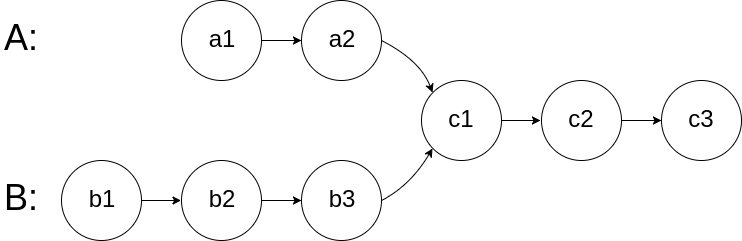
面试题 02.07. 链表相交 给你两个单链表的头节点 headA 和 headB ,请你找出并返回两个单链表相交的起始节点。如果两个链表没有交点,返回 null 。
图示两个链表在节点 c1 开始相交:
题目数据 保证 整个链式结构中不存在环。
注意 ,函数返回结果后,链表必须 保持其原始结构 。
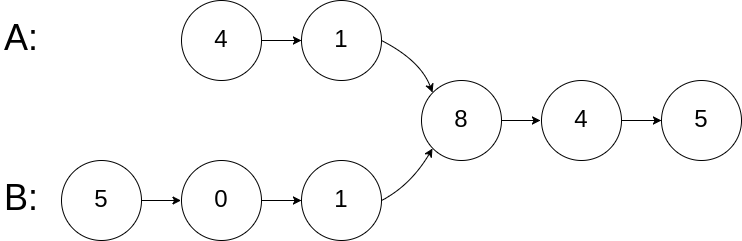
示例 1:
1 2 3 4 5 输入:intersectVal = 8, listA = [4,1,8,4,5], listB = [5,0,1,8,4,5], skipA = 2, skipB = 3 输出:Intersected at '8' 解释:相交节点的值为 8 (注意,如果两个链表相交则不能为 0)。 从各自的表头开始算起,链表 A 为 [4,1,8,4,5],链表 B 为 [5,0,1,8,4,5]。 在 A 中,相交节点前有 2 个节点;在 B 中,相交节点前有 3 个节点。
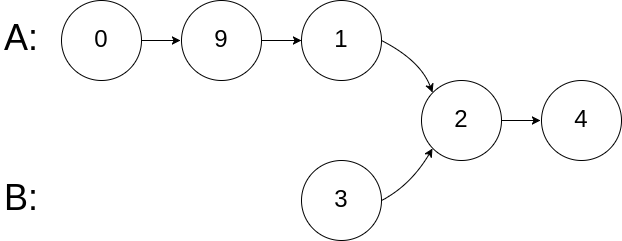
示例 2:
1 2 3 4 5 输入:intersectVal = 2, listA = [0,9,1,2,4], listB = [3,2,4], skipA = 3, skipB = 1 输出:Intersected at '2' 解释:相交节点的值为 2 (注意,如果两个链表相交则不能为 0)。 从各自的表头开始算起,链表 A 为 [0,9,1,2,4],链表 B 为 [3,2,4]。 在 A 中,相交节点前有 3 个节点;在 B 中,相交节点前有 1 个节点。
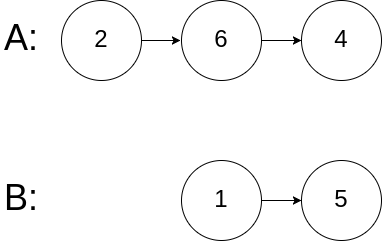
示例 3:
1 2 3 4 5 输入:intersectVal = 0, listA = [2,6,4], listB = [1,5], skipA = 3, skipB = 2 输出:null 解释:从各自的表头开始算起,链表 A 为 [2,6,4],链表 B 为 [1,5]。 由于这两个链表不相交,所以 intersectVal 必须为 0,而 skipA 和 skipB 可以是任意值。 这两个链表不相交,因此返回 null 。
思路:
求两个链表的交点,主要就是求两个链表指针开始相等的地方
两个链表相交 末尾的几个数值肯定相等
定位到末尾的位置 依次前进判断是否有相等的
代码:
1 2 3 4 5 6 7 8 9 10 11 12 13 14 15 16 17 18 19 20 21 22 23 24 class Solution : def getIntersectionNode (self, headA, headB ): lena,lenb=0 ,0 cura,curb=headA,headB while cura: cura=cura.next lena+=1 while curb: curb=curb.next lenb+=1 if lena>lenb: lena,lenb=lenb,lena cura,curb=curb,cura n=lenb-lena while (n): curb=curb.next n-=1 while cura: if cura==curb: return cura else : cura=cura.next curb=curb.next return None
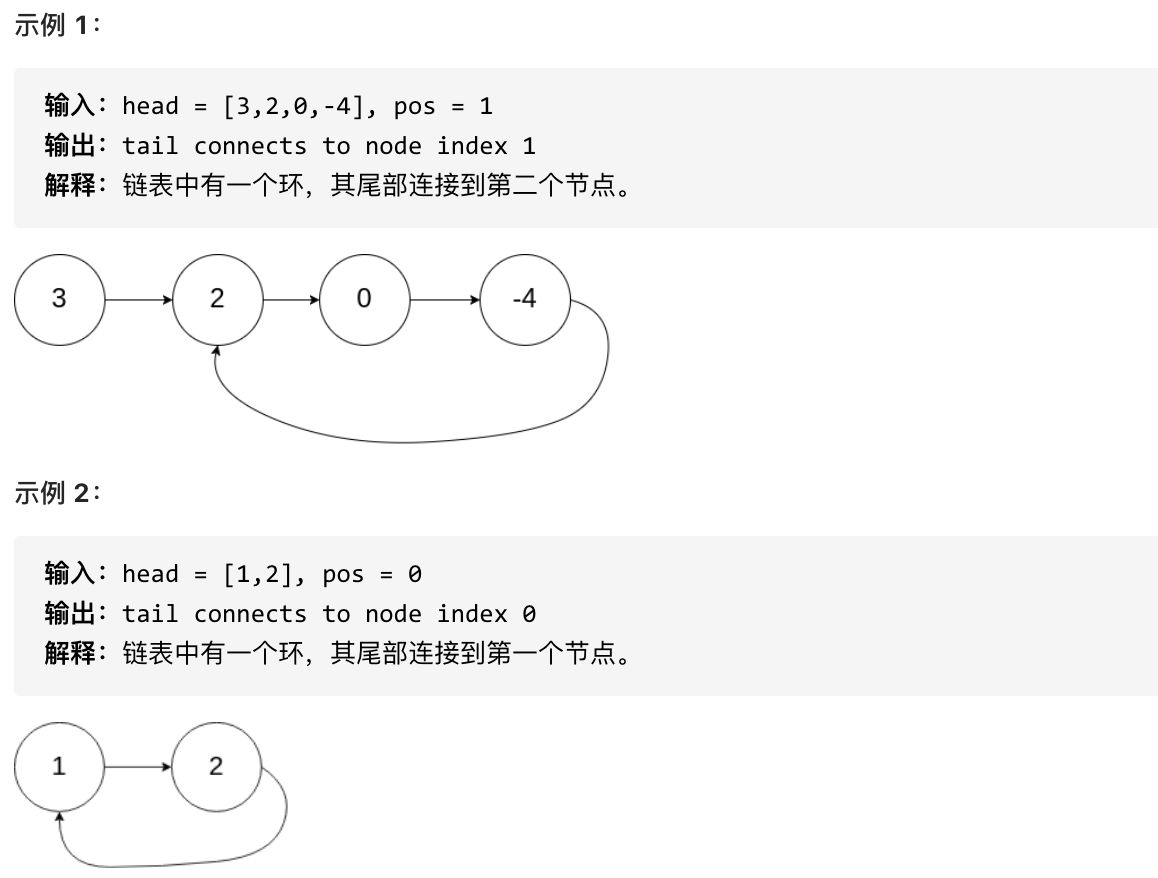
142.环形链表II 题意: 给定一个链表,返回链表开始入环的第一个节点。 如果链表无环,则返回 null。
为了表示给定链表中的环,使用整数 pos 来表示链表尾连接到链表中的位置(索引从 0 开始)。 如果 pos 是 -1,则在该链表中没有环。
说明 :不允许修改给定的链表。
思路:
关键是通过计算 计算x和z之间的关系 假设在某个点相遇 以此产生的数学关系
快指针以每次两步来移动,慢指针以每次一步来行动
当产生快指针等于慢指针时,可以确定一定存在环
假设起始位置到环起始点的距离为x,离环y距离为快慢指针的交点,距离环终点为z
将p指向链表起始点,q指向两者的交点,同时移动每次一步,当p,q相交,交点为环的起始点
公式为
$$
代码:
1 2 3 4 5 6 7 8 9 10 11 12 13 14 15 16 class Solution : def detectCycle (self, head ): slow, fast = head, head while fast and fast.next : slow = slow.next fast = fast.next .next if slow == fast: p = head q = slow while p!=q: p = p.next q = q.next return p return None